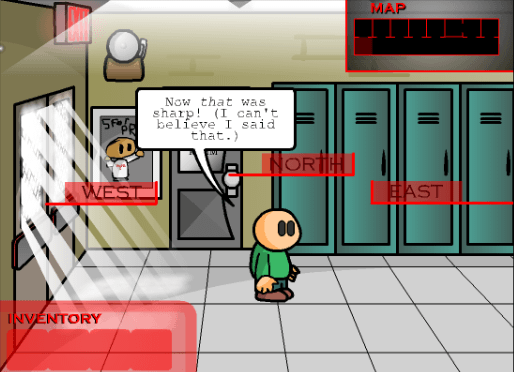
Boredom becomes a mission
Riddle School starts with a feeling almost everyone recognizes: the clock is moving too slowly and the classroom suddenly feels like a cage. The objective is wonderfully disproportionate. Instead of enduring the lesson, the hero decides to escape the entire school. That childish leap of logic establishes the comedy immediately.
Familiar rooms, unfamiliar rules
Hallways, lockers, offices, and supply closets require no elaborate explanation. Players already understand what these spaces are for. The puzzles become funny by misusing that knowledge. A mundane object may solve a ridiculous problem, while an authority figure can be distracted by a surprisingly small trick.
The power of a blank expression
The characters rarely need complex animation. Their simple faces and restrained reactions make strange conversations even funnier. A dramatic response would explain the joke. Riddle School trusts an awkward pause and a flat stare, letting the player supply the missing disbelief.
Pointing as performance
Every click carries a little comic timing. Players inspect suspicious objects, test unreasonable ideas, and occasionally discover that the unreasonable idea was correct. The interface makes curiosity part of the punchline because progress depends on behaving like the most persistent student in the building.
A small rebellion
Beneath the jokes is a compact fantasy about mastering a place designed to control movement. The player learns who holds each key, which rules can bend, and where the building hides its shortcuts. Escaping feels satisfying because the school changes from an institution into a puzzle the player understands better than its adults do.