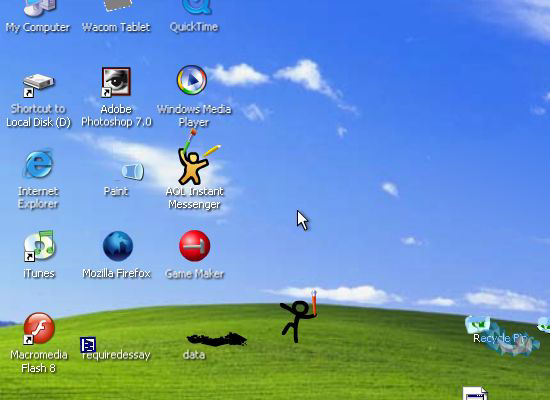
A blank stage
Animator begins with possibility rather than a finished performance. The player receives a figure, a timeline, and control over individual poses. That empty space can feel intimidating, but it also makes the first movement surprisingly meaningful.
Frames become behavior
Moving a limb once creates a pose. Moving it across several frames creates an action. The difference teaches a central lesson of animation: life appears between drawings. Timing determines whether a gesture feels heavy, nervous, smooth, or sudden.
Imperfection becomes style
Early experiments often wobble. Feet slide, joints snap, and actions happen too quickly. Those errors are useful because they reveal how the illusion is constructed. Adjusting one frame can change the personality of the entire sequence.
Repetition teaches rhythm
Playback turns scattered decisions into a continuous result. Watching, stopping, correcting, and watching again creates a tight creative loop. The player learns to anticipate motion before it happens, which is the beginning of directing rather than merely arranging.
A tool disguised as play
Animator sits between game and creative software. There may be no enemy to defeat, yet every improved sequence feels like progress. Its reward is authorship: the moment a stiff digital figure performs an action that existed first in the player’s imagination.
That small success can inspire a longer scene, a new character, or another experiment.