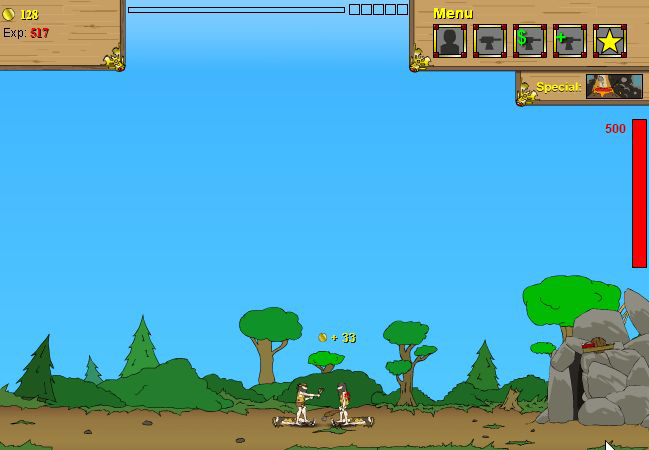
One lane, an entire history
Age of War compresses centuries into a single strip of contested ground. Cavemen shuffle out first, carrying simple weapons and modest ambitions. Much later, machines fill the same space with noise and fire. The battlefield barely changes, yet every new era makes it feel newly dangerous. That fixed lane is the game’s cleverest decision because it gives progress a permanent measuring stick.
Evolution you can see
Many upgrade systems hide improvement inside numbers. Age of War puts it directly on screen. Units change shape, weapons gain reach, and the base becomes more imposing. The jump between eras is dramatic enough to feel like a reward by itself. Players do not merely purchase stronger statistics. They watch their whole civilization acquire a new visual language.
Timing the leap
Advancing too early can leave a player poor and exposed. Waiting too long gives the opponent room to control the lane. That tension turns the evolution button into a strategic commitment. The best moment is rarely obvious, which keeps every match from becoming a simple race toward the future.
A battlefield that remembers
Because all fighting happens in one place, earlier mistakes remain emotionally present. A desperate defense in the first age makes later dominance feel earned. The same patch of ground that once seemed impossible becomes manageable, then familiar, then vulnerable again when the enemy evolves.
The long view
Age of War succeeds because its theme and mechanics agree. History becomes a sequence of tools, pressures, and temporary advantages. No era lasts forever. Victory belongs to the player who understands when to defend the present and when to spend everything on the future.